Table of contents
- The Family Model in Gulf Real Estate
- Boutique Versus Master Scale
- A Comparable Lineage
- What ZAYA Living’s Approach Looks Like in Practice
- Family-Led Decision Making and the Buyer Relationship
- The Broader Reshaping of the Villa Segment
- Where the Model Faces Pressure
- The Generational Horizon
- A Final Reading
In a market historically defined by the scale of its largest players, the appearance of a family-led, boutique villa developer making credible inroads is not a footnote. It is a small structural shift. ZAYA Living, the Dubai-based developer behind Lunaya by ZAYA, is one of a small handful of boutique houses currently reshaping the upper end of Dubai’s villa segment. Its emergence is worth examining not only as a commercial story but as a reflection of how the Gulf’s family-led property model has matured.
The dominant narrative of Dubai real estate has, for years, been written in the language of master developers. Emaar’s master plans, DAMAC’s branded residences, Nakheel’s archipelagic ambitions. Each operates at a scale that defines entire districts. Yet alongside these incumbents, a quieter generation of family-led developers has built a different kind of business, one organised around fewer projects, deeper architectural attention and a longer holding horizon. ZAYA Living belongs to that lineage.
The Family Model in Gulf Real Estate
Family-led businesses dominate the private economy across the Gulf. Forbes Middle East’s annual rankings of regional family conglomerates consistently feature houses whose roots reach back several generations and whose interests span hospitality, retail, contracting and real estate. The Al Habtoor family, with its hospitality and automotive interests, is one of the most visible examples. The model is not unique to property, but property is one of its most natural expressions.
The family-led approach in real estate produces a distinctive set of incentives. Decision-making cycles are shorter. Capital is patient. Reputational risk is borne directly by the family name, which tends to translate into a higher tolerance for quality investment and a lower tolerance for the kind of margin-driven shortcuts that occasionally surface in volume-driven projects. Khaleej Times has noted, in coverage of the segment, that family-led developers in the UAE often operate on multi-decade horizons that allow them to absorb cycle volatility without compromising their architectural standards.
ZAYA Living fits this template. The developer’s stated signature is detached luxury villas, a typology that, by its nature, resists the economies of scale that drive larger players toward apartment towers and townhouse rows. The choice to specialise in villas, on generous plots, with full privacy, is a commercial decision that aligns naturally with the family-led model.
Boutique Versus Master Scale
The distinction between boutique and master developers is not a matter of quality. The master developers, at their best, deliver architecturally serious work at considerable scale. The difference is one of operational logic. A master developer is, in effect, an urban planner with a balance sheet. Its product is the district as much as the home. A boutique developer is, by contrast, a craftsman. Its product is the home and, on the right project, the community immediately surrounding it.
ZAYA Living’s positioning has been built around the latter. The developer’s projects, including the gated community off SZR currently capturing the market’s attention, are designed at a scale that allows for individual attention to architecture, materials and landscape. The project counts are smaller. The plots are larger. The architectural language is more consistent across the development.
Arabian Business has, in its coverage of the UAE’s boutique developer segment, noted that this scale advantage has become increasingly relevant to a buyer base that has grown more discerning. Where the early Dubai cycles rewarded volume, the current cycle rewards differentiation. Buyers, particularly end-user families, are now asking questions about specification, finish quality and community programming that boutique developers are structurally better positioned to answer.
A Comparable Lineage
To understand ZAYA Living’s positioning, it helps to look at comparable lineages elsewhere in the region. In hospitality, the Al Habtoor family built a portfolio that operates on a different rhythm to the larger international chains, with a greater emphasis on signature properties and consistent ownership. In fashion and retail, families such as the Tabbara group have built businesses whose longevity has come precisely from their refusal to chase scale at the expense of identity.
The same logic applies in property. The boutique villa specialist, properly executed, occupies a defensible position in a market that the master developers, for structural reasons, cannot fully address. Villas at scale require land assemblies that are increasingly hard to secure in central Dubai. The remaining land, in the western corridor and along the Sheikh Zayed Road periphery, lends itself naturally to the smaller, higher-density boutique villa community. ZAYA Living has built its pipeline around precisely this kind of land position.
What ZAYA Living’s Approach Looks Like in Practice
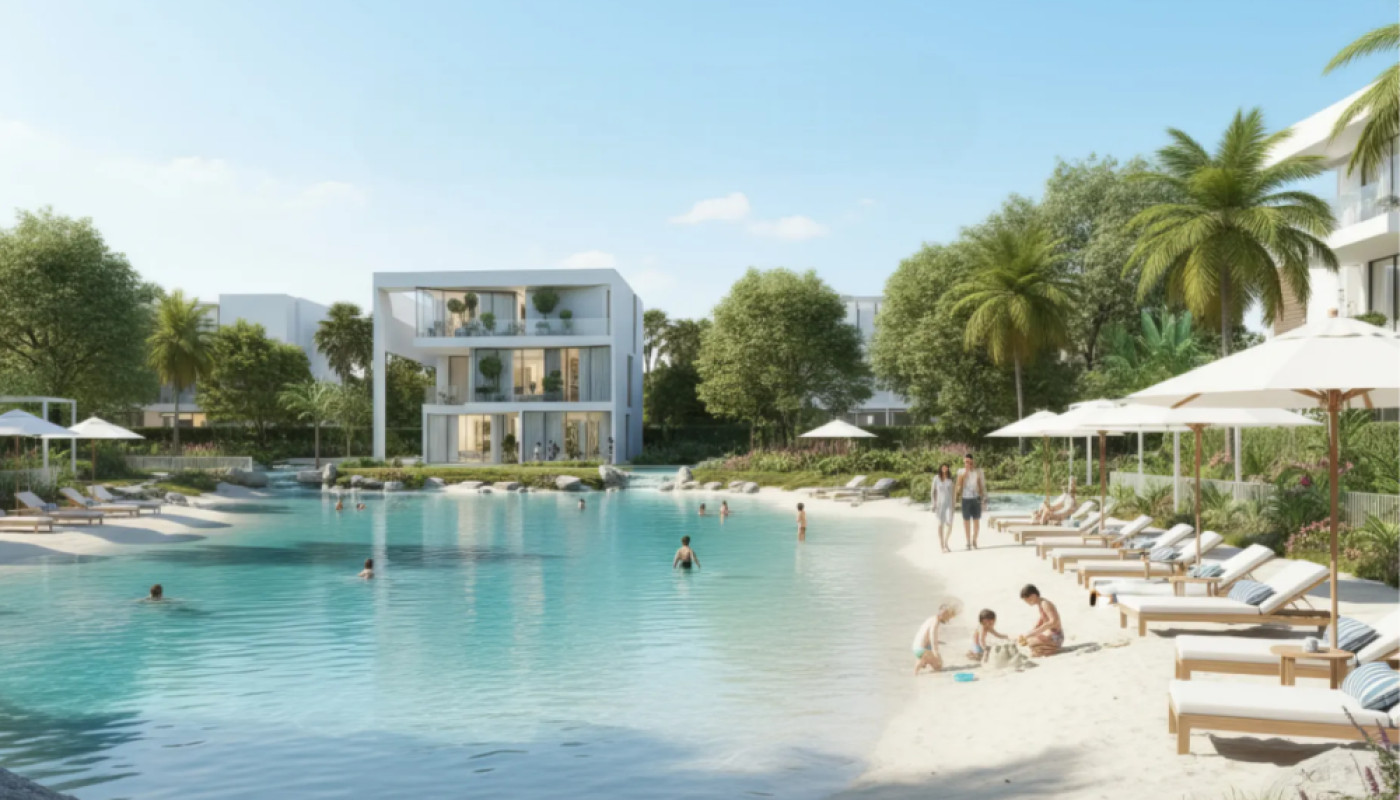
The most direct way to read a boutique developer is through its product. The villas at Lunaya, detailed in the materials published on the official Lunaya by ZAYA website, follow a contemporary Mediterranean design language that has gained ground in Dubai’s higher-end villa segment. Light stone, oak detailing, indoor-outdoor flow, generous landscaped gardens and private pools per villa. The architectural restraint, the absence of the maximalist gestures that occasionally characterise the larger players’ villa products, is itself a position.
The amenity programme follows the same logic. A central clubhouse, a kids club, a retail strip, padel and tennis courts. These are not unusual inclusions for a villa community at this price point. What distinguishes the boutique approach is the integration. Amenities at a master-scale villa community are often positioned as standalone destinations within a larger district. At a boutique development, they are sized and located to function as extensions of daily family life, within walking distance of every home.
This calibration is harder than it looks. Too much amenity, and the community begins to resemble a resort. Too little, and it loses the social texture that families increasingly expect. The boutique developer’s advantage is the ability to iterate at small enough scale that the calibration can actually be tuned.
Family-Led Decision Making and the Buyer Relationship
One of the less visible advantages of the family-led model is the buyer relationship. In a market where after-sales service has historically been uneven, the family-led developer carries reputational risk in a way that more diffuse corporate structures do not. The family name is on the door. The consequences of an unhappy buyer are personal, not just commercial.
This has practical effects on the buying experience. Brokers active on ZAYA Living’s projects have, in conversation, noted a level of access and responsiveness that contrasts with the more procedural rhythm of the larger developers. Decisions on specification adjustments, payment plan refinements and post-handover service are taken at a level close to the principals. For the kind of end-user family buyer that dominates the villa segment, this matters.
Forbes Middle East has, in its regional family business coverage, described this dynamic as one of the durable competitive advantages of the family-led property model. The buyer is not interfacing with a department. They are, in effect, interfacing with the family. The transaction acquires a different texture.
The Broader Reshaping of the Villa Segment
ZAYA Living’s emergence is part of a broader reshaping of Dubai’s villa segment that has accelerated over the past two years. The villa, long the secondary product type behind the apartment tower, has become the asset class with the most consistent supply-demand imbalance. Bayut’s data shows villa price appreciation outpacing apartments in median terms over multiple recent quarters. Knight Frank’s regional team has described the segment as structurally supply-constrained.
In a market with these characteristics, the boutique villa developer is well-positioned to capture meaningful market share. The master developers continue to dominate by volume, but the share of the segment occupied by the smaller, family-led houses has been expanding. ZAYA Living is one of the more visible examples of this expansion.
The implication for the broader market is not that the master developers will be displaced. It is that the villa segment will become more textured, with a wider range of products at the upper end and a clearer differentiation between scale-driven and craft-driven offerings. Khaleej Times has, in coverage of the segment, framed this as the maturation of the market.
Where the Model Faces Pressure
The family-led, boutique model is not without its tensions. The principal one is capital. The boutique developer does not have the balance sheet of the master developer. Project financing, land acquisition and the working capital required to deliver a villa community at the quality levels the segment demands all create pressure points that the larger players absorb more easily.
The successful boutique developers have generally addressed this by being disciplined about pipeline pacing. Rather than running multiple projects in parallel, they tend to deliver one at a time, with sufficient overlap to maintain operational continuity but not so much overlap as to overstretch capital. ZAYA Living, based on its current public pipeline, appears to follow this logic. The deliberate cadence is itself a form of quality control.
The second pressure point is talent. A boutique developer cannot match the in-house architectural and project management capacity of a master player. The successful houses have addressed this by building deep relationships with specialised consultants, often working with the same architectural and landscape teams across multiple projects. The continuity produces a coherent design language across the portfolio.
The Generational Horizon
One of the more interesting features of family-led developers in the Gulf is the generational horizon they operate on. The publicly traded master developers are accountable, in some measure, to the quarterly rhythm of analyst expectations. The family-led house is accountable, in a more direct sense, to the next generation that will inherit the business. The decision-making framework that this produces tends to weight long-term reputation more heavily than short-term financial performance, with practical consequences for the kind of work the developer undertakes.
Arabian Business has, in coverage of the regional family business landscape, noted that this generational accountability has become one of the structural advantages of the family-led model in the property segment. The houses that have successfully navigated multiple cycles have generally been those whose decision-making is anchored in the long-term, with the founder generation and the second generation working in close coordination on questions of project selection, architectural standard and operational quality. The boutique villa segment is particularly well-suited to this kind of decision-making, given the longer development cycles and the higher reputational stakes of each individual project.
ZAYA Living’s positioning fits this pattern. The developer’s deliberate cadence, its willingness to specialise in a single product category, and its emphasis on the architectural integrity of each project, all reflect the decision-making rhythm of a family-led house that is thinking in generations rather than quarters.
A Final Reading
Family-led developers are not new to Dubai. What is new is the level of credibility they now command in the upper end of the villa segment. ZAYA Living’s positioning, anchored in detached luxury villas, deliberate scale and a contemporary Mediterranean architectural language, has resonated with a buyer base that has grown more discerning. The success of the Lunaya villa community in its early launch phase is, in part, the success of that positioning.
The broader story is one of maturation. Dubai’s villa segment, long a secondary chapter behind the apartment tower, is acquiring the kind of textured, multi-tiered structure that more mature global luxury markets exhibit. The master developers continue to define the volume narrative. The boutique, family-led houses are defining the craft narrative. Both are necessary. ZAYA Living’s contribution to the second is, on the evidence of the current cycle, increasingly significant.
Similar articles

How Centralized Legal Services Simplify Your Move Abroad?

How Seamless Conveyancing Enhances Real Estate Transactions

How Simplified EU VAT Processes Boost Business Growth?

Real estate development in Sint Maarten: the future of luxury living

Exploring The Strategic Advantages Of Setting Up A Forex Company

Exploring The Perks Of Upscale Apartment Rentals In A Mediterranean City

Exploring Luxury Vacation Homes For Seasonal Rental In The Caribbean

Exploring Luxury Mountain Properties And Market Trends

Credit repurchase: its advantages and the steps to take

What supports should be used to save better?

Why use a financial consultant?

What to do before taking out a home loan?
